I do, weirdly enough, have a sommelier degree. However, with 2 little kids there is no way I have the time to taste my way through as many wines as I'd need,in order to be anywhere near confident in my wine knowledge. I know what I like, and tend to stick to buying the same type of wines over and over again. This is safe, but it does get boring. Therefore I sometimes like to take advice blindly. If someone recommends something I go for it, even though I might have this little voice somewhere saying "Is this really a good idea?". Well, the worst that can happen is that I buy a crappy wine, in most cases I get to try something new and delicious that I wouldn't have known about if I hadn't tried.
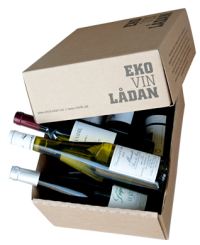
In Sweden, there is this company called Ekolådan. They most commonly deliver ecological vegetables to your door. When I found out they had this crate of ecological wines you can order I decided to give it a try. Check it out here (links to a page in Swedish).
There is a new crate for every season, I went for the "spring" one. There are 6 wines in a crate, in the one I got there were one rosé, 2 white ones (one fresh and one full flavoured) and 3 reds (one fruity, one spicy one full bodied). Also, a note came with the wines with some background info and serving suggestions.
The first wine we tried was the spicy red one: "Le 20 Rouge", 2008, from Appellation Côtes du Roussillon Contrôlée. It's made from syrah, grenache och carignan and described as tasting a lots of herbs like thyme, bay leaf, rosemary and pepper. It's supposed to be great served with lighter meat dishes and roasted root veggies.
This is, what I call, a very French wine. All elements are well integrated and nothing really sticks out, which makes it hard to describe. It's the "archetype of red wine" type of wine. There is fruitiness, most notably blackberries and dark cherries. Also some salami, smoke and pepper from the Syrah. There is a green and herby element as well, but I don't get all those herbs described by the vendor. It's medium bodied, 12.8% alcohol. The acidity is pretty high. The tannin bite is at medium. It's not a wine to enjoy by itself, it needs some food to go with it in order to really shine.
Is it a good buy? Hm, I not sure. You can buy a bottle at Systembolaget for 125 SEK. I think that's quite much. This is the sort of wine that French farmers drink by the cup to quench their thirst after a log days work at the arbour. It is a proper, but after all, pretty rustic wine. I'd be happy to give something like 80 SEK for it, but then, I don't how much is fair to add to the price as the wine is biodynamically made.
I improvised a dish to serve with the wine, round steak stuffed with garlic and herbs. In Swedish, round steak is called "rumpstek", and the Swedish name of my dish (örtfylld rumpstek) in direct translation in to English is "Herb stuffed ass roast". My son thought this was the funniest thing he'd heard in a long time and went on laughing about it for half a day. Sometimes I envy him his sense of humour!
Herb and garlic stuffed round steak, served with roasted root vegetables and feta sauce.
1 round steak
half a garlic
1 dl olive oil
big pinches each of dried rosemary, thyme, basil or whatever dried herbs you've got on hand. Fresh ones probably work great as well!
salt
pepper
carrots
potatoes
beetroots
feta
thick yoghurt
olive oil
Some hours in advance:
Make the marinade and stuffing: Run garlic, olive oil, herbs, salt and pepper in a blender.
Cut a big slash right into the meat, like you're cutting a cake into 2 layers, but don't slice all the way.
Rub the garlic and herb marinade onto the meat. Make sure that a lot of the garlic and herbs go into the slash.
Tie up the meat with a piece of string.
Let meat rest and marinate in a cool place.
About one hour before eating: Heat the oven to 200 degrees C.
Cut the root veggies into bite sized pieces. Spread them on a baking pan. Drizzle with olive oil, leftover herbs, salt and pepper.
Put veggies into the oven.
After 30 minutes: Lower oven temperature to 150 degrees C.
Put a thermometer into the meat, put meat in oven.
Roast the meat until termometer shows 58 degrees C. This took me half an hour.
Meanwhile, watch the root veggies, if they start getting to black for your liking, remove them from oven.
While meat is roasting, make the sauce.
Mash feta and stir in some yoghurt. Taste with olive oil, salt and pepper.
Tuesday, April 26, 2011
Thursday, April 21, 2011
Avocado and Shrimp Soup
Serves 1
1 avocado
15 unpeeled shrimps
1 tsp buillon powder
3 dl water
1 dl half and half
1 lime
chilli
Peel the shrimps, do not throw away the shells.
Put the shrimp shells in a pot, add the water and boullion powder.
Boil the shrimp shells for 10 minutes.
Meanwhile, mash the avocado, along with juice from half a lime in an blender.
Discard the shells, but collect the stock.
Add stock and cream to avocado.
Blend some more.
Add salt, chilli and more lime juice to taste.
Carefully warm the avocado soup.
Add the shrimps and maybe a some slices of lime as decoration
Serve.
Tuesday, April 19, 2011
Best Beef Tortillas Ever
| Before rolling up. |
If I'd name one dish that is my families summer signature dish it would be my husbands beef tortillas.
Best Beef Tortillas Ever
serves 3
2-3 beef steaks depending on how hungry you are
Yoghurt
Feta cheese
Avocado
Lime
Fresh Salsa (recipe below)
6-9 tortillas (again, depending on how hungry you are and the size of the tortillas)
First, grill the steaks. They are supposed to be red in the center and done on the outside. Cut them into strips.
Make the Fresh Salsa.
Ladle the yoghurt and feta cheese into bowls.
Cut the avocado in pieces, squeeze some lime juice over them.
Warm the tortillas in the oven, or over the barbecue.
Put everything on the table and assemble tortillas anyway you like.
| Fresh Salsa |
Fresh Salsa
20 cherry tomatoes
1 shallot
Bunch of cilantro
Chilli, as much as you can stand
Half a lime
Salt
Chop tomatoes, chilli, cilantro and shallot.
Squeeze in the lime.
Sprinkle over some salt.
Taste and adjust until it's just the way you like it.
Saturday, April 16, 2011
Noodle Soup
A staple all over Asia, it's very strange that it's so hard to order decent noodle soup at restaurants here in Sweden. I only know of one restaurant in Stockholm that does them ok and that's just not very many!
The key to a good noodle soup is to have good stock. For the best Pho you have to boil marrowbones for hours, lots of work. But for an everyday-using-up-all-leftovers I find it enough to boil some spices (star anise, a cinnamon stick, some cloves, peppercorns and schizuan pepper) in bouillon cube based stock.
This soup was done in that way. Boiling some spices. Chucking in cubes of tofu, leftover meat and half an egg. Top with coriander or whatever leafs you've got on hand. Done.
The key to a good noodle soup is to have good stock. For the best Pho you have to boil marrowbones for hours, lots of work. But for an everyday-using-up-all-leftovers I find it enough to boil some spices (star anise, a cinnamon stick, some cloves, peppercorns and schizuan pepper) in bouillon cube based stock.
This soup was done in that way. Boiling some spices. Chucking in cubes of tofu, leftover meat and half an egg. Top with coriander or whatever leafs you've got on hand. Done.
Thursday, April 14, 2011
Khao Klug Gapi
A while ago my husband came home from the supermarket with a bag full of green mangoes. "They were on sale", he said. Great I thought, you don't come across green mangoes everyday in Sweden.
I sat down and thought for a while, when I stayed in Thailand, what did we use green mangoes for? Then I remembered, "Kao Klug Gapi". A dish consisting of rice fried in shrimp paste, flanked with whatever tidbits you've got on hand that complement each other in flavour. In Thailand that typically is glacéed pork, shredded omelet, shredded green mango, lime wedges, minced shallots and a big pile of chillies. The ingredients are normally served separate so each eater takes whatever he or she like on her rice and mixes it all up just before eating.
Yep, said and done, this is my version og Khao Klug gapi:
Clockwise from upper left corner, lime wedges and shallots. Then shredded omelet, fried with a bit of fish sauce. Then the rice, fried with shrimp paste and garlic. Last, glacéed pork (glacéed with brown sugar and fish sauce) and mango.
Notice the color of the mango. When I cut up those great green mangoes they were all yellow on the inside. Clearly not the same type of mango as we get in Thailand that tend to be the same color inside and out, but a good sweet mango nevertheless. And it worked out great in this dish that way as well.
I sat down and thought for a while, when I stayed in Thailand, what did we use green mangoes for? Then I remembered, "Kao Klug Gapi". A dish consisting of rice fried in shrimp paste, flanked with whatever tidbits you've got on hand that complement each other in flavour. In Thailand that typically is glacéed pork, shredded omelet, shredded green mango, lime wedges, minced shallots and a big pile of chillies. The ingredients are normally served separate so each eater takes whatever he or she like on her rice and mixes it all up just before eating.
Yep, said and done, this is my version og Khao Klug gapi:
Clockwise from upper left corner, lime wedges and shallots. Then shredded omelet, fried with a bit of fish sauce. Then the rice, fried with shrimp paste and garlic. Last, glacéed pork (glacéed with brown sugar and fish sauce) and mango.
Notice the color of the mango. When I cut up those great green mangoes they were all yellow on the inside. Clearly not the same type of mango as we get in Thailand that tend to be the same color inside and out, but a good sweet mango nevertheless. And it worked out great in this dish that way as well.
Tuesday, April 12, 2011
New cookbooks
It's not that I've been neglecting the blog lately, it's just that we've had stomach flues again and again now and they do not help inspiring your cooking. Right now this feels like "The Year when I only ate sandwiches and take aways", but I don't know, hopefully this will change.
To combat the general murkyness that goes with staying at home being sick I've ordered stuff on the internet. And not just any stuff, I've ordered more cookbooks. So whenever we're ready for same great home cooked goodyness I will be ready!
These are the ones I've got, I'm starting with the English ones:
"Kansha - Celebrating Japans Vegan and Vegetarian Traditions" by Elizabeth Andoh. I'm widely impressed with her former book "Washoku" on Japanese home cooking, so I decided to get this one as well. Looks good this far.
"Moosewood Resturant Cooks for Health" by the Moosewood Collective. Before I had kids the Moosewood book were my go to everyday cookbooks. There are so many great vegetarian recipes in there. Based on dishes from all over the world. Unfortunately their style does not go down well with my son. But I still love them so I couldn't resist this one.
And the Swedish ones:
"Surdegsbröd" (Sour Dough Breads) by Marin Johansson. He has a great blog on sour dough baking. I've been following it for a while now and decided it was time for me to give something back - so I got the book.
And saving the best for last:
"Om jag var din hemmafru eller hur man får en vardag att smaka som en lördag" (If I was your housewife or how to get a working day to taste like a Saturday) by Lotta Lundgren. The spirit in this one is like nothing I've encountered before, here is a small excerpt (translation errors are all mine):
"Pasta Bolognese, the Swedish households culinary equivalent of the missionary. A reoccurring everyday happening that most of us adults have mastered and do appreciate. But when time goes by we start to ask ourselves, isn't there something we could do to develop, refine or vary it? And then I say, have you ever tried it with a carrot?"
To combat the general murkyness that goes with staying at home being sick I've ordered stuff on the internet. And not just any stuff, I've ordered more cookbooks. So whenever we're ready for same great home cooked goodyness I will be ready!
These are the ones I've got, I'm starting with the English ones:
"Kansha - Celebrating Japans Vegan and Vegetarian Traditions" by Elizabeth Andoh. I'm widely impressed with her former book "Washoku" on Japanese home cooking, so I decided to get this one as well. Looks good this far.
"Moosewood Resturant Cooks for Health" by the Moosewood Collective. Before I had kids the Moosewood book were my go to everyday cookbooks. There are so many great vegetarian recipes in there. Based on dishes from all over the world. Unfortunately their style does not go down well with my son. But I still love them so I couldn't resist this one.
And the Swedish ones:
"Surdegsbröd" (Sour Dough Breads) by Marin Johansson. He has a great blog on sour dough baking. I've been following it for a while now and decided it was time for me to give something back - so I got the book.
And saving the best for last:
"Om jag var din hemmafru eller hur man får en vardag att smaka som en lördag" (If I was your housewife or how to get a working day to taste like a Saturday) by Lotta Lundgren. The spirit in this one is like nothing I've encountered before, here is a small excerpt (translation errors are all mine):
"Pasta Bolognese, the Swedish households culinary equivalent of the missionary. A reoccurring everyday happening that most of us adults have mastered and do appreciate. But when time goes by we start to ask ourselves, isn't there something we could do to develop, refine or vary it? And then I say, have you ever tried it with a carrot?"
Wednesday, March 30, 2011
White Chocolate-Cocoa Nib Mendiants
Mendiants are little chocolate discs, topped with anything you like. They originate from France where mendiant means "beggar of alms". Traditionally they used to be topped with blanched almonds, raisins, hazelnut and dried figs in order to represent the white, grey, brown and purple robes worn by, respectively, Dominican, Franciscan, Carmelite and Augustinian friars. But nowadays, of course, anything goes.
I made mine with white chocolate and cocoa nibs. These work wonderfully together, the sweetness and softness of the white chocolate perfectly balances the bitterness and crunch of the nibs.
Other combos I'm curious about are white chocolate and matcha powder. Or white chocolate and bitter beer granules. Not that I've ever heard that anyone has invented those yet, but that doesn't stop me from thinking about them.
I made mine with white chocolate and cocoa nibs. These work wonderfully together, the sweetness and softness of the white chocolate perfectly balances the bitterness and crunch of the nibs.
Other combos I'm curious about are white chocolate and matcha powder. Or white chocolate and bitter beer granules. Not that I've ever heard that anyone has invented those yet, but that doesn't stop me from thinking about them.
Tuesday, March 29, 2011
Coconut Water
Coconut Water is one beverage that I miss a lot from Thailand. It's the watery liquid found inside young coconuts. It's nothing like coconut milk, which is made by pressing the mature coconut "flesh", but light and delicate with a slight flowery taste. In Thailand, it's usually served with a straw right from the coconut. When the water is drunk you can spoon out the coconut gel - that is the stuff that, when the coconut ages, will transform into regular coconut flesh.
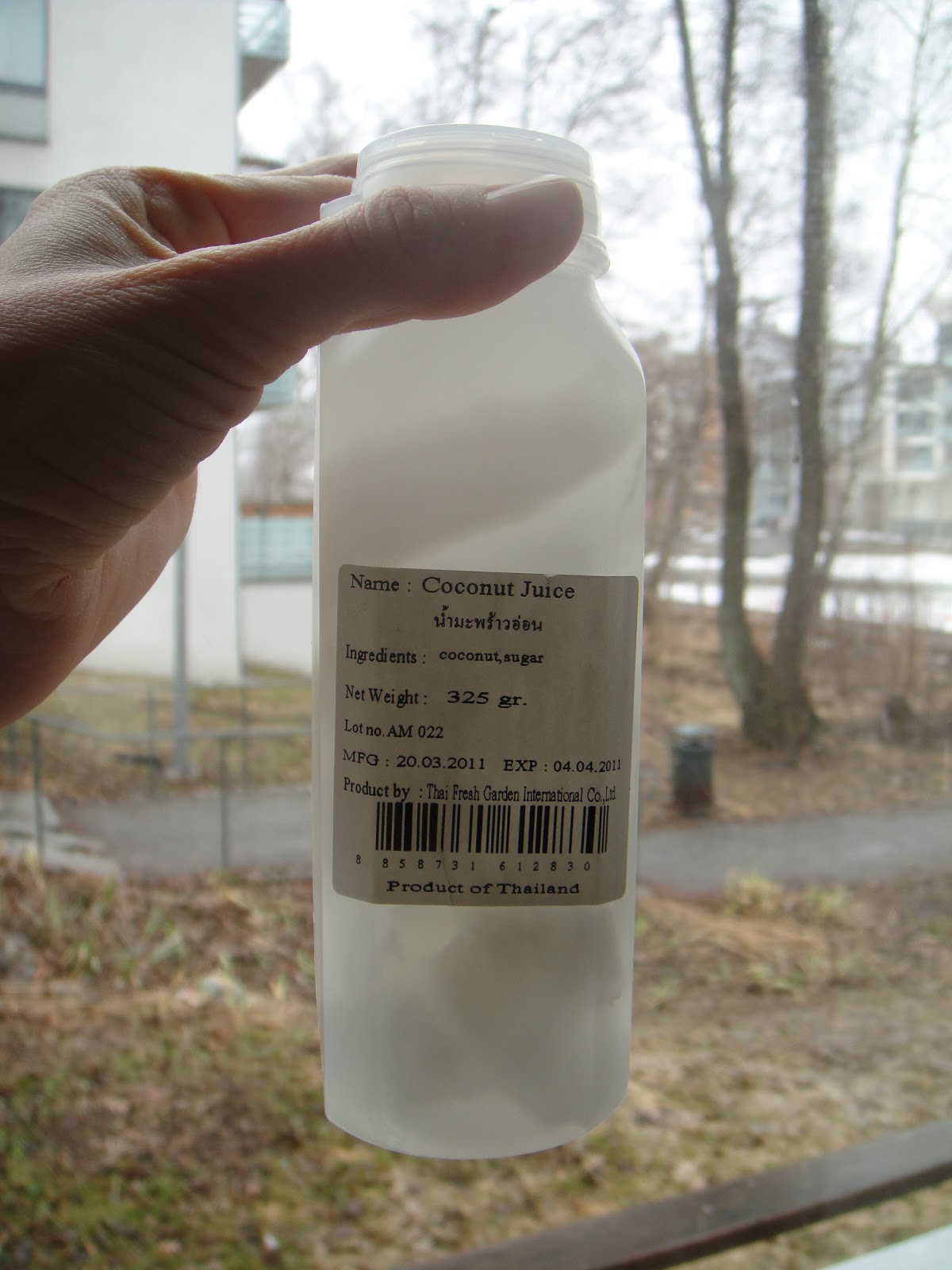
In Sweden there are several canned versions of coconut water. The ones I've tried before have all been really bad, either way to sweet or with a strange artificial note added to it. But at my latest Asian Supermarket haul I came across a good one:
The label says it does contain sugar, but I didn't find it any sweeter than the stuff coming right out of a coconut. Also, you can see the coconut gel floating around in the bottle.
Another thing I learnt in Thailand, if you drink coconut water while having your period the bleeding decreases. This is also true for having star fruit (carambole). I've no idea why but this is something that all Thai women seem to be aware of. Good to know when on a beach holiday :)
In Sweden there are several canned versions of coconut water. The ones I've tried before have all been really bad, either way to sweet or with a strange artificial note added to it. But at my latest Asian Supermarket haul I came across a good one:
The label says it does contain sugar, but I didn't find it any sweeter than the stuff coming right out of a coconut. Also, you can see the coconut gel floating around in the bottle.
Another thing I learnt in Thailand, if you drink coconut water while having your period the bleeding decreases. This is also true for having star fruit (carambole). I've no idea why but this is something that all Thai women seem to be aware of. Good to know when on a beach holiday :)
Monday, March 21, 2011
Ginger Tea
I've been on a cooking break for 2 weeks now. Started with the kids getting stomach flu. I didn't get "really" sick, but some kind of half way hybrid kind of sick, loosing appetite, big fatigue etc. I'm not going to be graphic on this but let me tell you, when taking care of stomach flu patients you don't really feel like making anything you'll ever might want to eat again. We're all well now but my cooking hasn't taken off since that. But I hope that will change within the next few days!
One last Korean thing that is a great pick-me-up when not feeling so good, especially around the stomach area. Ginger Tea. Just smash up a piece of ginger, the older and drier, the more flavour in the end. Boil it for 10 minutes. Add some honey and done.
Tuesday, March 1, 2011
Cooking on the edge - kimchi with shrimps
I'm not sure if this is a good idea or not but I just started another batch of kimchi, this time I added 50 grams of dried shrimps. Feels like a crazy thing to do, after all, the kimchi is supposed to last for a month or two, and sefood is not something you should keep around that long. But, the recipe called for salted shrimps, and I've read as well that people sometimes throw in raw oysters into their kimchi so I thought, what the hell, I'm giving it a try. Hopefully I'll be able to smell if things are starting to go seriously wrong (does that sound like some last famous words or what).
Subscribe to:
Posts (Atom)